GIMS is the substrate. Every operational entity is a noun; every operation on it
is a verb. Every verb is logged, signed, lineage-tracked, and recoverable.
The information layer is not a database; it is a grammar.
Its origins are in the laboratory information world (samples becoming subdivisions
becoming analyses becoming artifacts), but the abstraction generalizes. Anywhere the
question "what happened to this thing, when, by whom, and on whose authority"
matters, GIMS is the answer.
And in the GUTS factory, GIMS graduates: from a workflow application that proved the
grammar in a regulated lab to the institutional ledger every organ writes
into. The factory's memory layer is not a new system; it is this one.
Modern organizations run on a graveyard of disconnected information systems: CRMs that
forget what the email thread said, spreadsheets that lose their context the moment they
change hands, "shared drives" with no lineage, ticket systems that don't know which
artifact they refer to. The substrate is not actually there.
The cost compounds: every cross-team handoff is a small re-discovery, every audit is a
reconstruction project, every "who decided this" question is a chase through Slack. The
organization has memory only in the sense that water has memory — the shape was there
briefly and then it dissolved.
What This Is Not
GIMS is not a database, a CRM, or a Notion clone
The category errors here are everywhere. A relational DB stores nouns and forgets verbs.
A graph DB stores edges and forgets time. A CRM stores customers and forgets context.
Notion stores prose and forgets structure. GIMS is the union — and the union has
a name: an operational grammar.
The grammar is small: every event is subject — verb — object — at — by — under.
Every operation is a fully-formed sentence. The substrate is the corpus.
01 · ENTITIES ARE NOUNS
Every operational thing — a customer, a contract, a code module, a hire, a deliverable,
a sample — is a noun with an id, a type, a state, and an origin. The noun is
first-class. It exists independent of any specific tool it happens to live in.
02 · OPERATIONS ARE VERBS
Anything that happens to a noun is a verb: created, signed, transferred, split,
analyzed, approved, retired. Verbs carry timestamps, actors, and authority. Verbs
chain — the output of one is the input of the next. The whole operational
history of a noun is a sentence you can read.
03 · LEDGER IS APPEND-ONLY
Verbs never get edited or deleted. Corrections are themselves verbs (correct,
supersede, retract) that reference what they correct. The ledger is the full
truth, audit-compliant by construction, recoverable to any past state.
04 · COMPLIANCE BY CONSTRUCTION
Because every transformation carries actor + timestamp + authority + before/after state,
GIMS is compliance-ready without retrofitting. ISO 9001, 21 CFR Part 11, SOX, GDPR,
HIPAA — these regimes ask questions the grammar already answers. Audit is a
query, not a project.
The Factory Ledger
GIMS in the factory — the institutional ledger
The lab proved the grammar; the factory adopts it. MVP 2, the next rung of the build,
defines four new record families for the agentic factory, all written as the same
subject — verb — object — at — by — under sentences. The grammar doesn't
change. The sentences get a factory to describe.
05 · THE EVENT SPINE MVP 2 · next
Every Bridge and session action will land as one event sentence: source, event_type,
session_id, references to the goal and task it serves, a risk level, and a
human_required flag. Nothing in the factory acts without leaving one. This is
the rung where GIMS stops being adjacent to the factory and becomes its memory.
06 · THE SESSION LEDGER MVP 2 · next
One record per tmux worker body: role, project, worktree, branch, status,
created_by, last_heartbeat. Absence becomes computable: a session that should be
heartbeating and is not is a fact you can query, not a surprise you discover at the
terminal.
07 · WORK CLAIMS MVP 2 · next
Scoped, expiring ownership over specific paths, with claim_type read, write,
review, or exclusive_write. This is how parallel agents avoid collision: before a
worker touches a path it will take a claim, and the claim is a sentence any other
worker can check before it moves.
08 · EPISODES MVP 3 · with GONS-Core
GONS-Core will package raw session life into reviewable episodes: objective, actors,
timeline, artifacts, outcome, candidate labels. Episodes are what GEDS digests,
never raw terminal logs. The ledger keeps the raw sentences; the episode is their
curated retelling, and it is a sentence too.
The discipline is imported, not invented: the same append-only, attributable, tamper-evident
record-keeping the compliance derivative sells into pharma is what the factory trusts its
own memory to. No capability before its observability. Memory before
autonomy.
Compliance Substrate
The regimes the grammar already handles
Compliance is a hot topic precisely because most information layers can't answer
basic provenance questions. When the grammar carries actor, time, and authority on every
verb, the regimes that hurt other organizations are reduced to read queries.
REGULATED INDUSTRIES
21 CFR Part 11 · ISO 13485
Pharma, medtech, biotech. Electronic-record-and-signature regimes. The lineage and authority requirements built into GIMS were originally lab-grade.
DATA REGIMES
GDPR · HIPAA · CCPA
Right of access, right of erasure, breach notification. All become queries against the ledger — not policy documents that hope someone follows them.
FINANCIAL & QUALITY
SOX · ISO 9001
"Show me the controls and the lineage." A grammar with append-only verbs and explicit authority is a controls system that doesn't need a controls system.
The Defining Capability
A substrate that compounds instead of decays
Three years in, an auditor asks: "Who approved the change to the data pipeline on
2024-08-12, and what was the state of customer-record-9714 immediately before that
change?" A normal organization would lose a week reconstructing it. A GIMS-backed
organization runs two queries and has the answer in under a minute — with the actor, the
authority chain, the before-and-after, and the verbs that connect them.
That's not a compliance win. It's an epistemic one. When the substrate
is real, every other organ — GEDS especially — has something to run on. Without GIMS,
the rest of the cortex is inferring over a fog. With it, the inference has bedrock.
Where It Fits
GIMS in the stack
GIMS is L1 of the factory stack: the substrate every other organ sits on. The built
Bridge sits below it and will feed it; the designed organs above it will write and read
through it; the human audits it from outside the stack altogether. The other organs
have state; GIMS is state.
GIMS — The Ledger
Nouns, verbs, time, authority. The operational grammar every other organ will write into and read from.
← BRIDGE · built
Will emit its first event sentences at MVP 2. Today it stores nothing but the auth cookie: the window shipped before the memory, by design.
← GONS · designed, split in two
GONS-Core will be the heaviest writer — the event stream, the session ledger, heartbeats, episodes — and will read state back to run the floor. GONS-Console will answer the human with citations into those same records.
→ GEDS · designed
Will digest episodes packaged from the ledger, never raw terminal logs. Higher-quality substrate, higher-quality inference.
← GOMS · designed
Every decomposition, goal to campaign to sprint to task, will be recorded as lineage. Future plans can query how past plans actually went.
GEMS · GAMS · GRAMS — later layers
GEMS is a read-view over GIMS, since artifacts are already ledger sentences. GAMS and GRAMS will write allocation and market verbs when they exist. None of them gate the factory.
GIMS is the only organ that compounds. Every other organ has a current state;
GIMS has the full trajectory. That trajectory is what makes the cortex worth anything in
year five.
The Build
From grammar to working system
GIMS is the first organ with a deployed implementation. It began as a response to a specific
market failure: laboratories paying top dollar for proprietary LIMS software that didn't
serve them — locked in by black-box code with no exit path that still met regulatory
compliance. The result is a working proof of the grammar. Every screen in the section below
is live software, not a mockup.
01
Compliance Log
Append-only record of every operation — who, what, when, under whose authority. The ledger is the truth.
02
Data Entry
Structured noun population with customizable schemas. Spreadsheet-grade ergonomics, hard to break by design.
03
Workflow Tracking
Linear and graph-mode step completion per project. Errors, quarantines, and holds are first-class states.
04
Lineage View
Full noun trajectory — submission history, referenced runs, overrides, and derivation chain, readable in both directions.
05
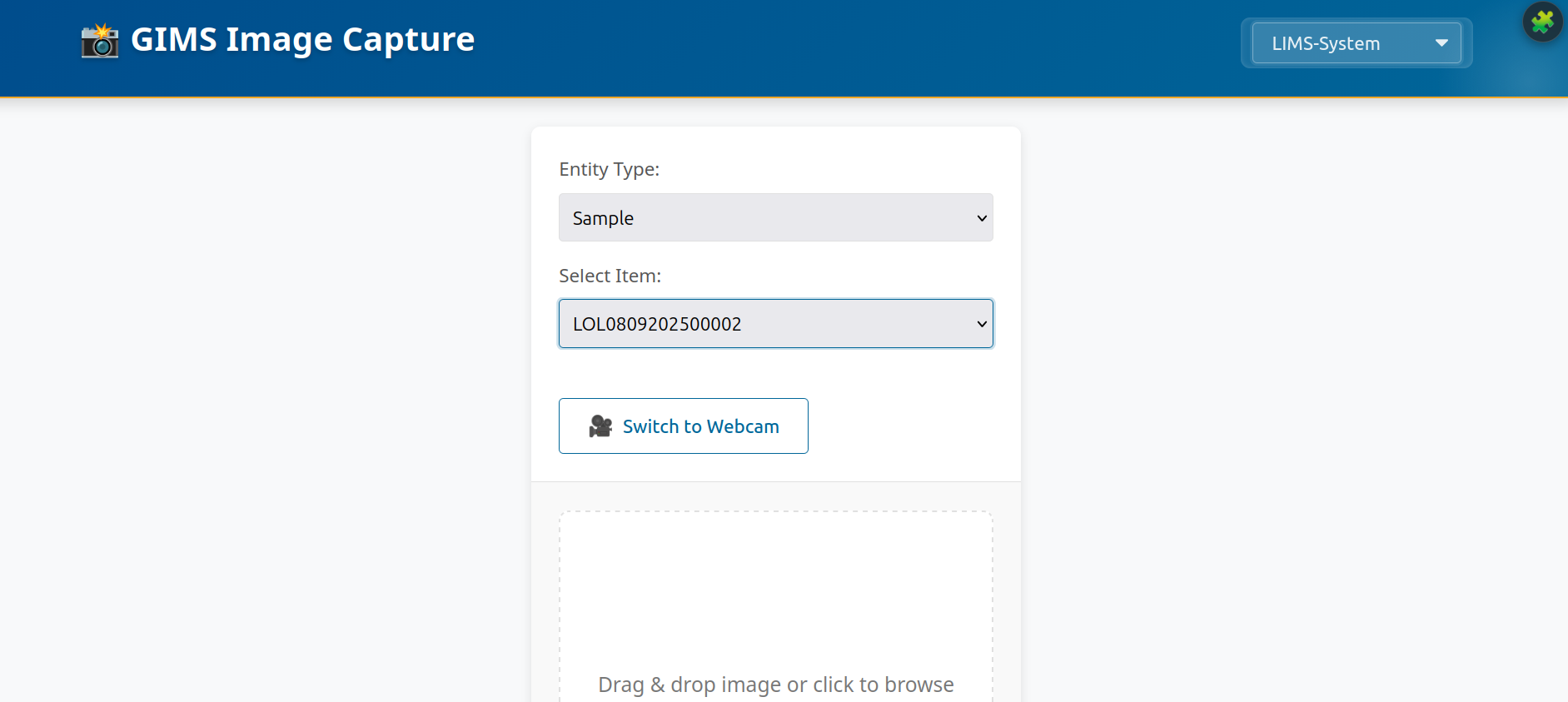
Image Capture
Webcam or file upload, bound to sample nouns. Visual context becomes part of the record — origin-stamped and queryable.
06
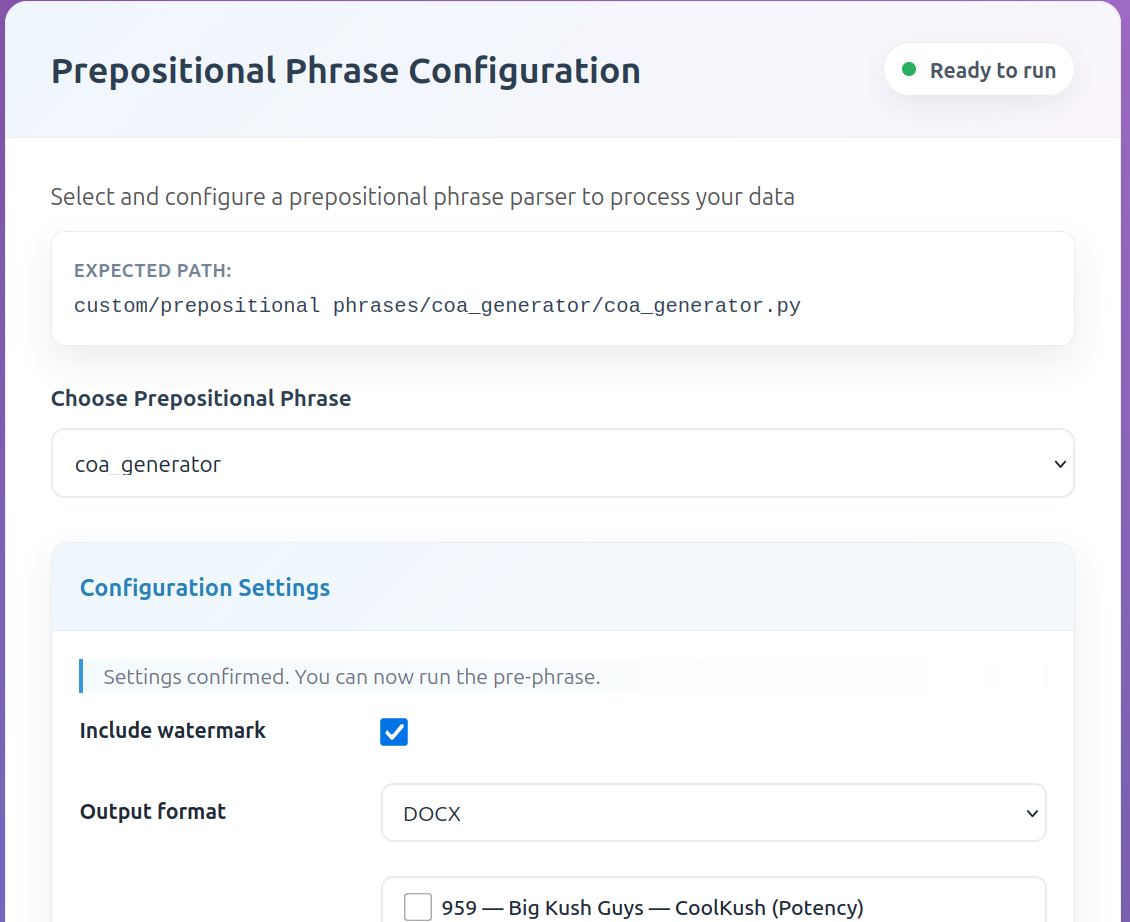
Artifact Generation
COAs, reports, certificates — generated from the grammar substrate, not reconstructed from memory or filled by hand.
07
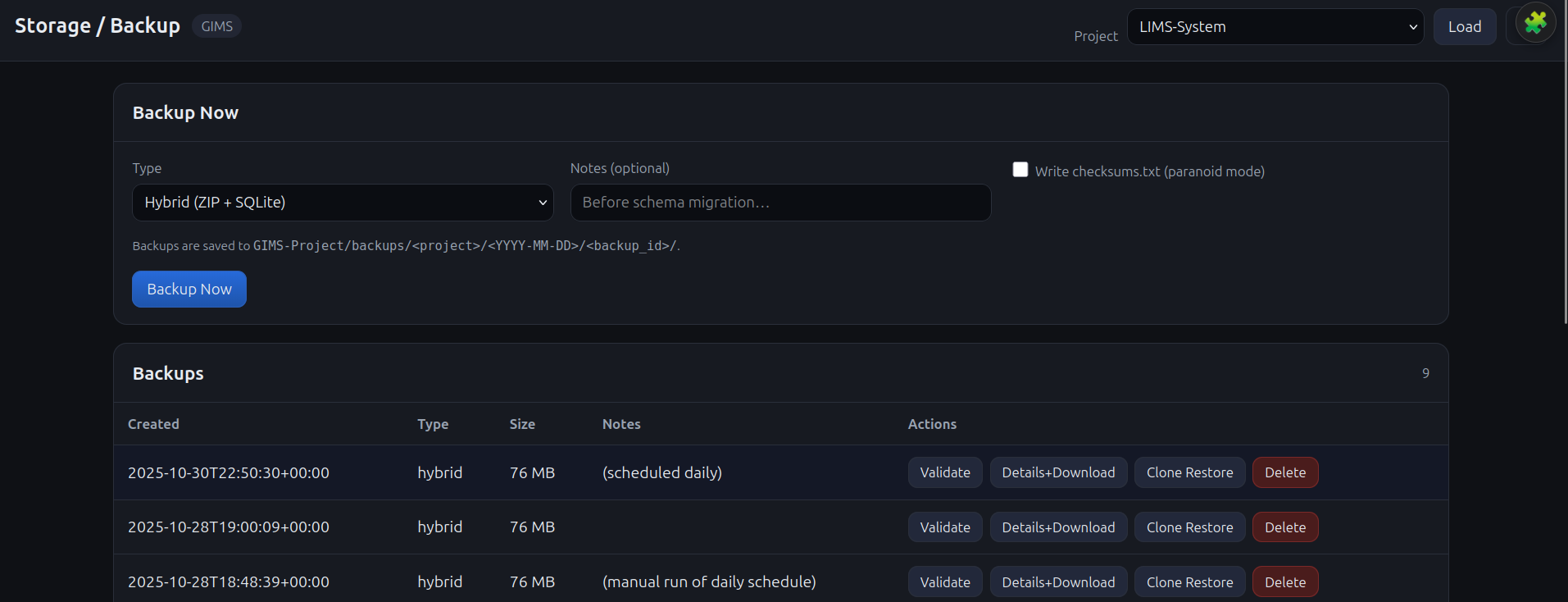
Backup & Recovery
Scheduled and manual hybrid backups (ZIP + SQLite) with checksum validation. Recovery is the easiest part of a catastrophic failure.
08
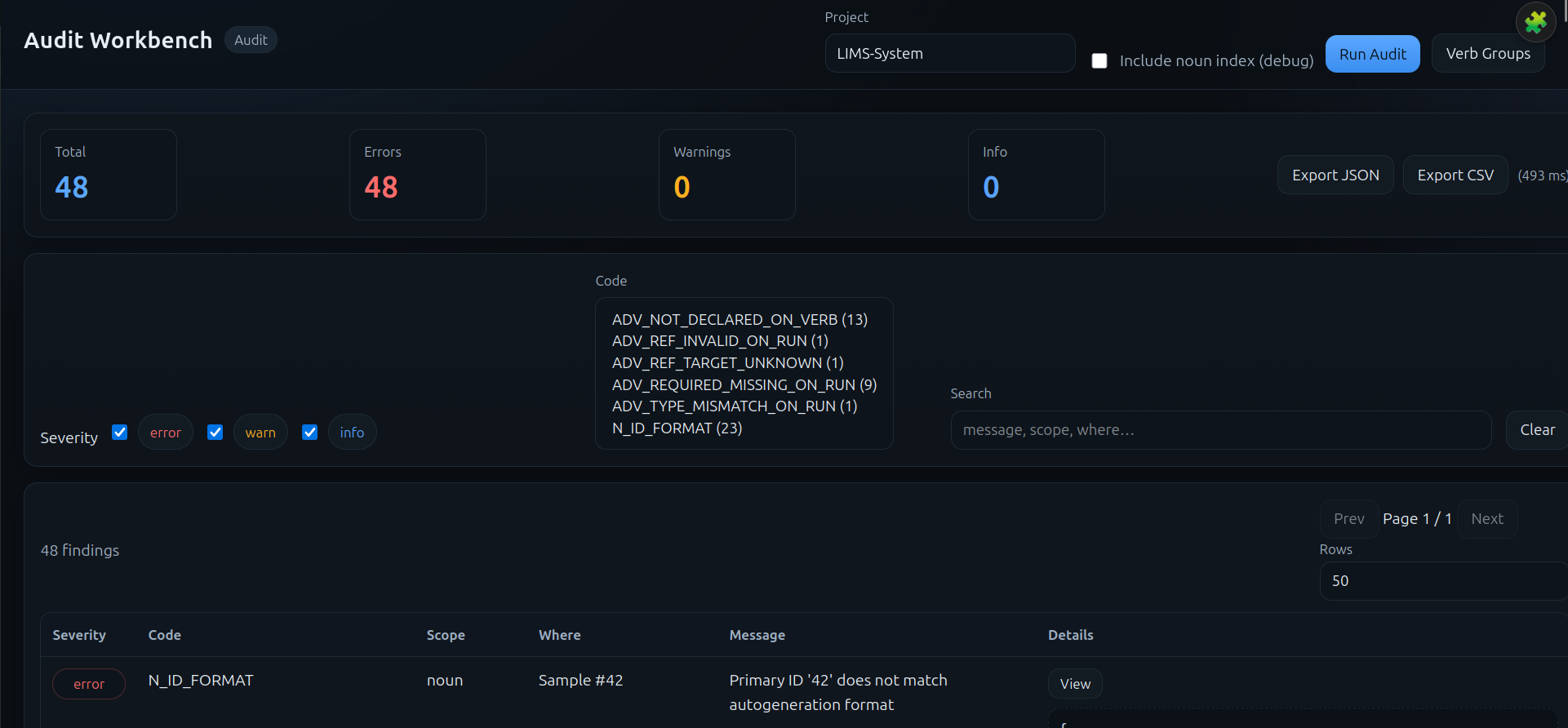
Audit Workbench
Built-in meta-audit surfacing structural inconsistencies — ID format violations, missing fields, orphaned records. The grammar audits itself.
System in Use
Eight screens from the deployed system
Each screen below corresponds directly to an architectural claim made earlier on this page.
The grammar is not a metaphor — it is a query language, a schema engine, a lineage tracker,
and an audit system, deployed into a regulated laboratory workflow.
Core Data — Nouns & their population
Noun Population
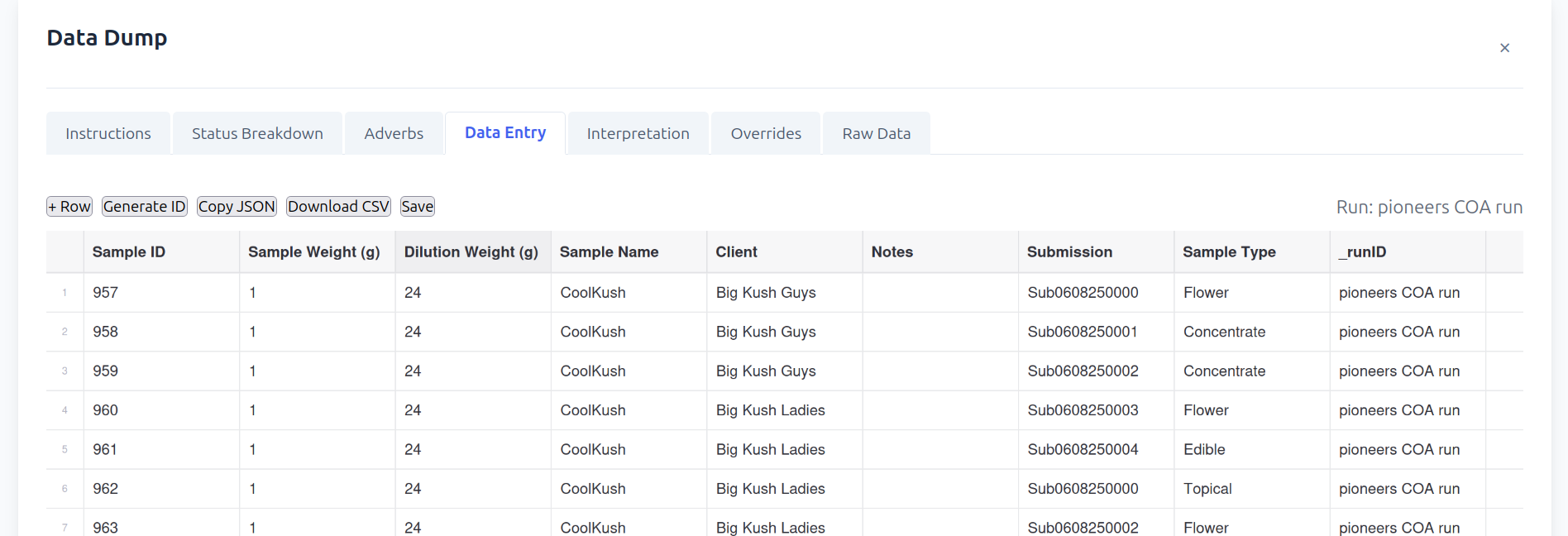
Data Entry
Structured tabular entry against project schemas. Sample IDs, weights, clients, submission codes — nouns being written into the grammar with full field validation and per-row context.
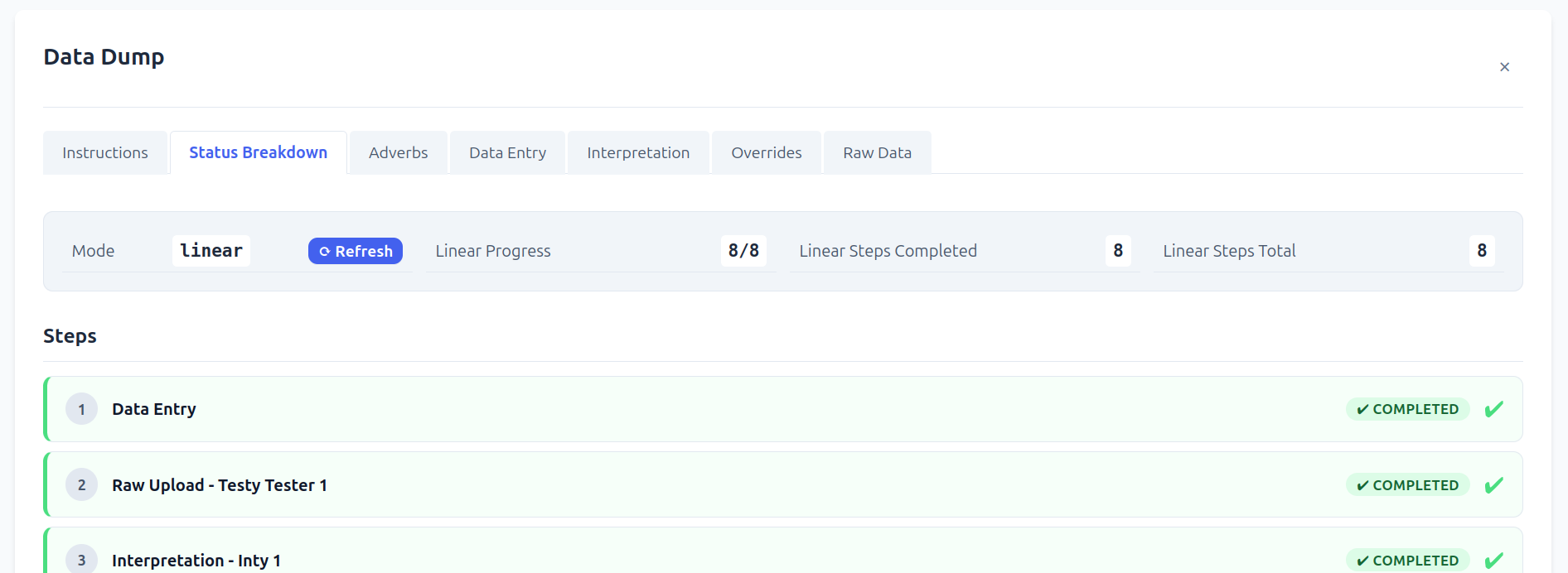
Verb Chain Status
Workflow Completion
Linear mode showing 8/8 steps completed — Data Entry through Raw Upload, Interpretation, and beyond. Step state is tracked per noun, not per process instance, so partial completions and re-runs are native.
Audit & Lineage — The ledger that compounds
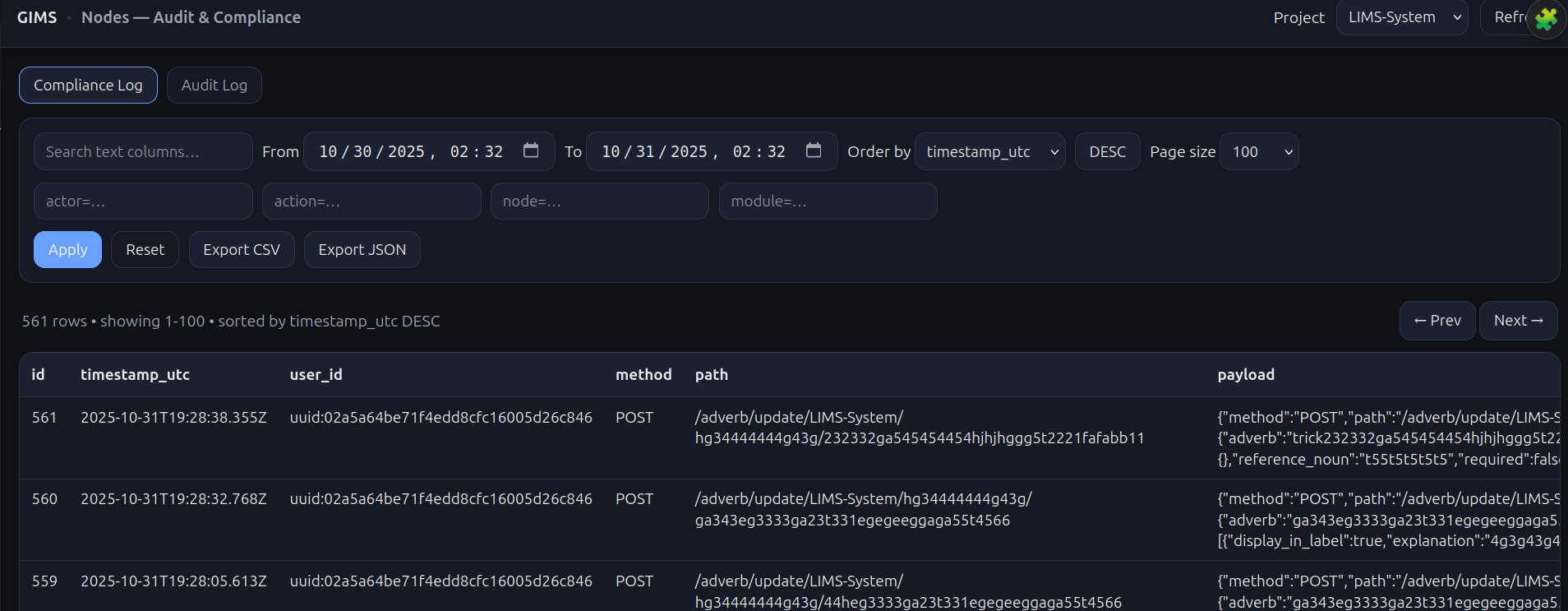
Append-Only Ledger
Compliance Log
Every system event — POST, GET, mutation — with timestamp, authenticated user, method, path, and payload. The regulator's question becomes a filter, not a reconstruction project.
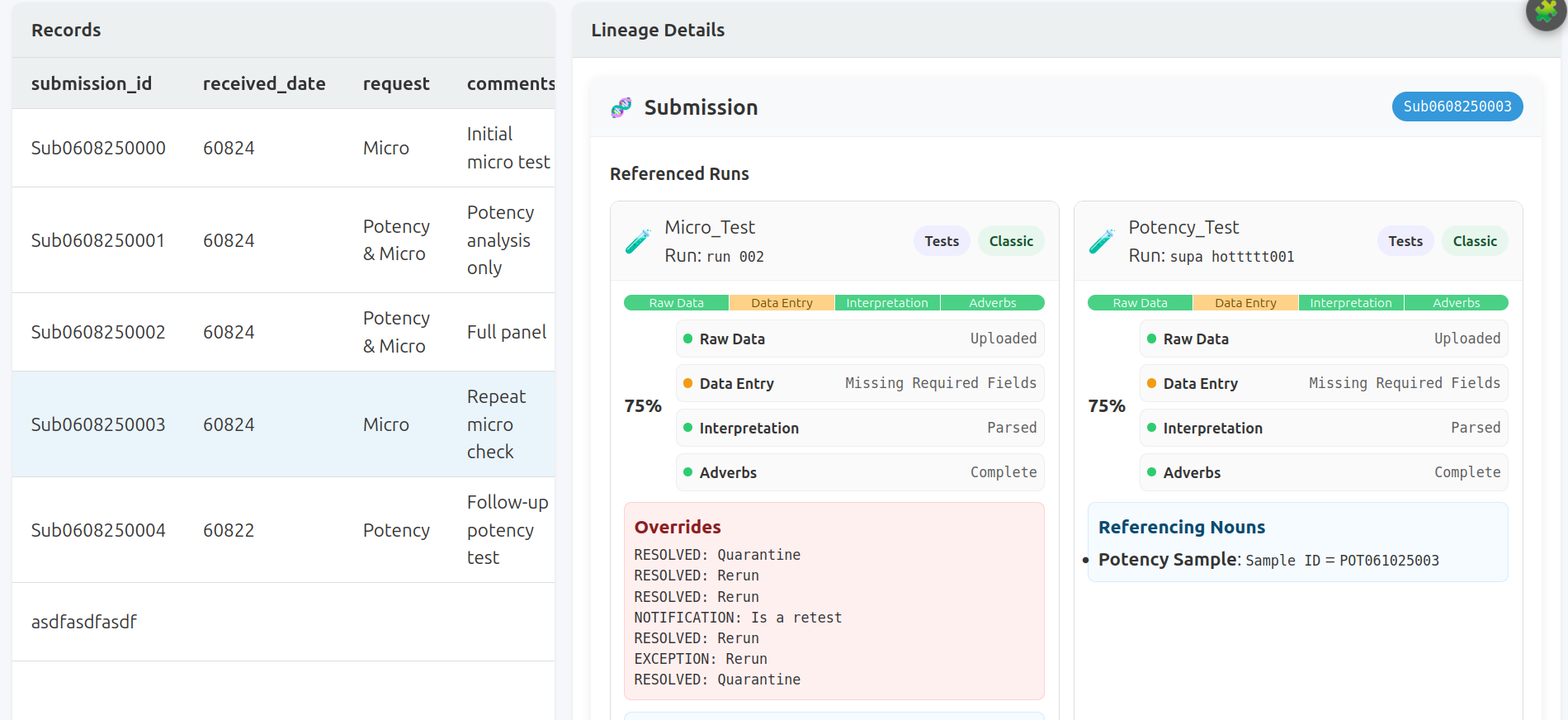
Noun Trajectory
Lineage Details
Submission record with referenced runs, progress per run, overrides, quarantines, and derived nouns. The full sentence of a noun's life — readable forward and backward, showing causal chain intact.
Meta-Audit
Audit Workbench
Built-in audit surfacing structural inconsistencies — noun ID format violations, missing required fields, invalid verb targets. Exportable as JSON or CSV. The grammar audits itself; findings are actionable, not alarming.
Supporting Capabilities — Depth beyond core data
Visual Nouns
Image Capture
Webcam or file upload, bound directly to a sample entity. Images become first-class nouns in the grammar — origin-stamped, entity-linked, and queryable like any structured record.
Artifact Generation
COA Generator
Certificate of Analysis generated directly from the substrate. Watermark, format, and sample selection configured once. The document emerges from the grammar — it does not need to be composed by hand from remembered data.
Substrate Durability
Storage & Backup
Scheduled and manual hybrid backups (ZIP + SQLite) with per-backup checksum validation, details download, and clone-restore. Recovery is designed to be the easiest part of a catastrophic hardware failure.
Derivative Product
GIMS Compliance Relay
The full GIMS implementation led to a narrow-scope commercial derivative: a compliance
capture layer for file-writing instruments in regulated environments. The relay demonstrates
a second property of the grammar architecture — that it can be attenuated for
specific regulatory contexts without losing its essential character.
GIMS · Compliance Relay
Tamper-evident audit capture for instruments that only write files.
NMR workstations and other regulated instruments produce valuable primary data without
providing the user attribution, append-only logging, and tamper evidence that regulated QA
workflows require. The relay closes that specific gap — without touching the instrument
workflow — by watching configured folders and converting file-creation events into
21 CFR Part 11-supportable compliance records.
It is intentionally attenuated: regulated environments already have controlled workstations,
authenticated OS logins, and enterprise backup. Rebuilding those inside the application adds
validation scope with no compliance upside. The relay integrates with existing infrastructure
rather than duplicating it.